Annals of Nuclear Resistance

Peace and Planet Mobilization April 26, 2015
Photo courtesy of Libero Della Piana - used by permission
From the Ban the Bomb movement to peace and planet summer, for seven decades people have resisted the menace of nuclear weapons that overshadow life on planet Earth.

This blog is dedicated to stories of protest and resistance, calls for nuclear disarmament, remembering those who have made and do make significant contributions to peace.

These are extraordinary stories. It has been an honor and privilege to recruit the material for the blog as a United for Peace and Justice project for Nuclear-Free Future Month and Peace and Planet Summer.

Saturday, April 9, 2016

Another kind of Nuclear Security Summit: The Marshall Islands vs. the Nuclear-Armed States

09.04.2016 - The Hague, The Netherlands - Pressenza Budapest

Another kind of Nuclear Security Summit: The Marshall Islands vs. the Nuclear-Armed States
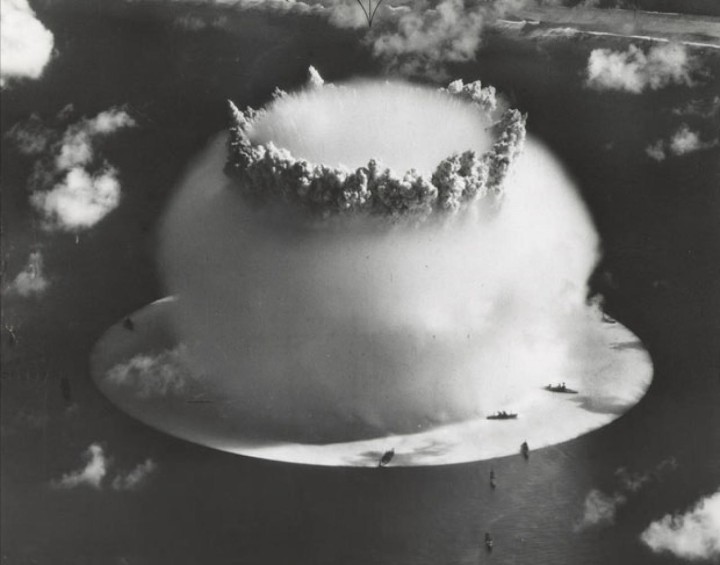
A 21 kiloton underwater nuclear weapons effects test, known as Operation CROSSROADS (Event Baker), conducted at Bikini Atoll (1946). (Image by U.S. Army Photographic Signal Corps)

By Jacqueline Cabasso
The recent Nuclear Security Summit hosted by President Obama in Washington, DC generated a goodly amount of hype, including some well-deserved criticism of its narrow focus on securing civilian highly enriched uranium (HEU) and other modest, voluntary steps aimed at preventing terrorists from acquiring weapons-useable nuclear and radiological materials. The Summit was silent on the huge stocks of HEU and plutonium in military programs and the more than 15,000 existing nuclear weapons possessed by States, including the Summit’s host – the only country that has used nuclear weapons in war.
Another kind of nuclear security summit took place last month in The Hague, as the tiny Pacific nation of the Marshall Islands took on three nuclear-armed giants before the highest court in the world. Hubris and hypocrisy on one side, courage and vision on the other were on global display.
In April 2014, the Republic of the Marshall Islands (RMI) initiated proceedings in the International Court of Justice (ICJ) against all nine nuclear-armed nations, the United States, Russia, the United Kingdom, France, China, India, Israel, Pakistan and North Korea, contending that each of them is in breach of its obligations under the Nuclear Non-Proliferation Treaty (NPT) and/or customary international law to end the nuclear arms race and to engage in negotiations on nuclear disarmament.

Tuesday, March 1, 2016

Accidental Nuclear War: A Timeline of Close Calls

The Future of Life Institute has put together a timeline of "nuclear close calls" that you can see at the link below:

http://futureoflife.org/background/nuclear-close-calls-a-timeline/

No to the Trident nuclear submarine renewal

As reported in the Guardian newspaper, tens of thousands of people gathered in central London for an anti-nuclear weapons protest on Saturday, February 27, 2016.

Parliament is considering renewing the Trident submarine at a cost of more than £100 billion.  Speakers at the rally included actress Vanessa Redgrave and Labour leader Jeremy Corbyn.

U.S. peace organizations including United for Peace and Justice sent messages of solidarity.

Wednesday, January 27, 2016

Doomsday Clock at Three Minutes to Midnight

The Bulletin of the Atomic Scientists is keeping the Doomsday Clock at three minutes to midnight.

Counterpunch has posted this article from Ira Helfand, Co-President of International Physicians for the Prevention of Nuclear War (1985 Nobel Peace Laureate group).
- www.counterpunch.org - http://www.counterpunch.org -

Ticking Toward Doomsday

Recently, the Bulletin of the Atomic Scientists announced it was keeping its famous Doomsday Clock at three minutes to midnight. In making this decision, their panel of experts, including 16 Nobel Laureates, cited the  growing danger of nuclear war.
The danger of nuclear war?
For most people today, the threat of nuclear war isn’t even on their radar screens.  It needs to be.
When the Cold War ended most of us started to act as though the danger of nuclear war had gone away. It didn’t. There remain in the world today some 15,000 nuclear war heads, 95 percent in the arsenals of the US and Russia. More than 2,000 of these warheads are on hair-trigger alert. They are mounted on missiles that can be launched in 15 minutes. And all nine counties that possess nuclear weapons are actively modernizing their arsenals at a cost of hundreds of $billions.
For the last quarter century we have been told we don’t need to worry about these weapons. The US and Russia weren’t enemies anymore and they would never be used. The recent conflicts in Ukraine and Syria and the irresponsible nuclear saber rattling by both sides have shown us how hollow these assurances are. There is a real danger that some crisis could spiral into direct conflict between the US and Russia.
We also have to worry about the possibility of accidental nuclear war. On at least five occasions since 1979 either Moscow or Washington prepared to launch nuclear war in the mistaken belief that it was already under attack.

Monday, January 25, 2016

January 25, 2015 nuclear weapons protest at long-time weapons contractor Draper Laboratories in Kendall Square, Cambridge Massachusetts.  They develop guidance systems for nuclear weapons (among other kinds of weapons systems).  In the 1980's a group called Ailanthus (after the hardy tree) protested weekly for years.

Friday, December 18, 2015

Origins of Japan's Nuclear Program

Joseph Gerson shared this article with the Massachusetts Peace Action Nuclear Abolition Task Force.  It comes from Muto Ichiyo from Japan - a noted scholar, long concerned about the underlying power politics of nuclear weapons policy.

Friday, December 11, 2015

IRRADIATED - a new report from McClatchy

From "Killing Our Own" the aptly titled book from 1982 by Harvey Wasserman and Norman Solomon to today's new report "IRRADIATED" information abounds about the consequences of nuclear weapons manufacture. This of course, is quite apart from use of nuclear weapons - 50 to 100 would destroy planet Earth, with nuclear winter.

Soldiers who witnessed nuclear explosions saw the bones of their own hands and later died of radiation-induced cancers.  Workers at all phases of the nuclear cycle have suffered exposure to uranium and even plutonium, resulting in all kinds of cancers.

Highlights from the report (thanks to McClatchy for doing this research):

For the last year, McClatchy journalists conducted more than 100 interviews across the country and analyzed more than 70 million records in a federal database obtained under the Freedom of Information Act.

Among the findings:
  • McClatchy can report for the first time that the great push to win the Cold War has left a legacy of death on American soil: At least 33,480 former nuclear workers who received compensation are dead. The death toll is more than four times the number of American casualties in the wars in Afghanistan and Iraq.
  • Federal officials greatly underestimated how sick the U.S. nuclear workforce would become. At first, the government predicted the program would serve only 3,000 people at an annual cost of $120 million. Fourteen years later, taxpayers have spent sevenfold that estimate, $12 billion, on payouts and medical expenses for more than 53,000 workers.
  • Even with the ballooning costs, fewer than half of those who’ve applied have received any money. Workers complain that they’re often left in bureaucratic limbo, flummoxed by who gets payments, frustrated by long wait times and overwhelmed by paperwork.
  •  Despite the cancers and other illnesses among nuclear workers, the government wants to save money by slashing current employees’ health plans, retirement benefits and sick leave.
  • Stronger safety standards have not stopped accidents or day-to-day radiation exposure. More than 186,000 workers have been exposed since 2001, all but ensuring a new generation of claimants. And to date, the government has paid $11 million to 118 workers who began working at nuclear weapons facilities after 2001. 


  • For the last year, McClatchy journalists conducted more than 100 interviews across the country and analyzed more than 70 million records in a federal database obtained under the Freedom of Information Act.

    Among the findings:


    McClatchy can report for the first time that the great push to win the Cold War has left a legacy of death on American soil: At least 33,480 former nuclear workers who received compensation are dead. The death toll is more than four times the number of American casualties in the wars in Afghanistan and Iraq.
    Federal officials greatly underestimated how sick the U.S. nuclear workforce would become. At first, the government predicted the program would serve only 3,000 people at an annual cost of $120 million. Fourteen years later, taxpayers have spent sevenfold that estimate, $12 billion, on payouts and medical expenses for more than 53,000 workers.
    Even with the ballooning costs, fewer than half of those who’ve applied have received any money. Workers complain that they’re often left in bureaucratic limbo, flummoxed by who gets payments, frustrated by long wait times and overwhelmed by paperwork.
    Despite the cancers and other illnesses among nuclear workers, the government wants to save money by slashing current employees’ health plans, retirement benefits and sick leave.
    Stronger safety standards have not stopped accidents or day-to-day radiation exposure. More than 186,000 workers have been exposed since 2001, all but ensuring a new generation of claimants. And to date, the government has paid $11 million to 118 workers who began working at nuclear weapons facilities after 2001.

    Read more here: http://media.mcclatchydc.com/static/features/irradiated/#storylink=cpy