On December 16, 2016 a Resolution was adopted by the General Assembly at the United Nations to discuss banning nuclear weapons.
None of the nuclear weapons states voted for the resolution, effectively isolating themselves from the rest of the world which seeks to ban these genocidal/ecocidal weapons by pushing (forcing?) the nuclear nations to live up to their treaty obligations under the NPT to disarm.
Meetings at the U.N. will be held March 27 to 31, and June 15 to July 7, 2017 and a Women's March to Ban the Bomb is scheduled for June 17th in New York City.
Annals of Nuclear Resistance
 |
| Peace and Planet Mobilization April 26, 2015 Photo courtesy of Libero Della Piana - used by permission |
This blog is dedicated to stories of protest and resistance, calls for nuclear disarmament, remembering those who have made and do make significant contributions to peace.
These are extraordinary stories. It has been an honor and privilege to recruit the material for the blog as a United for Peace and Justice project for Nuclear-Free Future Month and Peace and Planet Summer.
Wednesday, March 22, 2017


Fukushima Six Years On
from Counterpunch magazine - March 2017
by John LaForge
March 11 marked the 6th anniversary of the world’s worst nuclear reactor disaster: the 2011 meltdown of three large power reactors on the Pacific Coast of Japan—Fukushima Daiichi—following a staggering 9.0 magnitude earthquake— the biggest in recorded Japanese history—and its 50-foot tsunami. The “station blackout” or total loss of electric power and cooling in six reactors, and the consequent hydrogen explosions and uncontrolled overheating and “melt-through” of three reactors, has resulted in the most devastating and complicated radiation catastrophe in history.
Fukushima is regularly misreported as less drastic than the singe-reactor catastrophe at Chernobyl, in Ukraine, in 1986. But France’s Institute for Radiological Protection and Nuclear Safety, reported five years ago that Fukushima was already the biggest single spill of man-made radioactive ma- terials into to the marine environment ever seen or recorded. At least 300 tons of highly contaminated runoff have poured daily into the Pacific ever since.
Dr. Helen Caldicott says in the documentary short Fukushima: Beyond Urgent, that aired Feb. 13 says, “Japan is by orders of magnitude many times worse than Chernobyl.” In Crisis Without End (2014), Caldicott warned: “The Fukushima disaster is not over and will not end for many millennia. The radioactive fallout, which has covered vast swaths of Japan, will remain toxic for hundreds of thousands of years. It cannot simply be ‘cleaned up,’ and it will continue to contaminate food, humans, and animals.”
The disaster of “Fukushima squared” (earthquake + tsunami + station blackout, times three melted reactor cores) was caused by deliberate decisions made by General Electric, Tokyo Electric Power Co. and the government: to build reac- tors in earthquake zones; to place emergency back-up gener- ators in flood-prone basements; and to ignore long-standing warnings about inadequate seawall protection.
For these reasons, Nukewatch never calls what’s happened at Fukushima an accident. Rather, we believe with Mayor Tamotsu Baba, of the town of Namie, who said in August 2011 that his “people were unnecessarily exposed....” and that the government’s withholding of warnings about radioactive fallout was comparable to “murder.”
Radiation-caused illnesses, cancers and fatalities that result from reactor disasters (Windscale in England, Three Mile Island in Pennsylvania, Chernobyl in Ukraine, and Fukushima) are scientifically predictable and known in advance. Researcher Arnie Gunderson noted two years ago that “Two reports recently released in Japan, one by Japanese medical professionals and the second from Tokyo Electric Power Corp., acknowledged that there will be numerous cancers in Japan, much greater than normal, due to the ra-dioactive discharges from the triple meltdown at Fukushima Daiichi... I believe, as do many of my colleagues, that there will be at least 100,000 and as many as one million more cancers in Japan’s future as a result of this meltdown... The second report received from Japan proves that the incidence of thyroid cancer is approximately 230 times higher than normal in Fukushima Prefecture... So what’s the bottom line? The cancers already occurring in Japan are just the tip of the iceberg. I’m sorry to say that the worst is yet to come.”
March 11 marked the 6th anniversary of the world’s worst nuclear reactor disaster: the 2011 meltdown of three large power reactors on the Pacific Coast of Japan—Fukushima Daiichi—following a staggering 9.0 magnitude earthquake— the biggest in recorded Japanese history—and its 50-foot tsunami. The “station blackout” or total loss of electric power and cooling in six reactors, and the consequent hydrogen explosions and uncontrolled overheating and “melt-through” of three reactors, has resulted in the most devastating and complicated radiation catastrophe in history.
Fukushima is regularly misreported as less drastic than the singe-reactor catastrophe at Chernobyl, in Ukraine, in 1986. But France’s Institute for Radiological Protection and Nuclear Safety, reported five years ago that Fukushima was already the biggest single spill of man-made radioactive ma- terials into to the marine environment ever seen or recorded. At least 300 tons of highly contaminated runoff have poured daily into the Pacific ever since.
Dr. Helen Caldicott says in the documentary short Fukushima: Beyond Urgent, that aired Feb. 13 says, “Japan is by orders of magnitude many times worse than Chernobyl.” In Crisis Without End (2014), Caldicott warned: “The Fukushima disaster is not over and will not end for many millennia. The radioactive fallout, which has covered vast swaths of Japan, will remain toxic for hundreds of thousands of years. It cannot simply be ‘cleaned up,’ and it will continue to contaminate food, humans, and animals.”
The disaster of “Fukushima squared” (earthquake + tsunami + station blackout, times three melted reactor cores) was caused by deliberate decisions made by General Electric, Tokyo Electric Power Co. and the government: to build reac- tors in earthquake zones; to place emergency back-up gener- ators in flood-prone basements; and to ignore long-standing warnings about inadequate seawall protection.
For these reasons, Nukewatch never calls what’s happened at Fukushima an accident. Rather, we believe with Mayor Tamotsu Baba, of the town of Namie, who said in August 2011 that his “people were unnecessarily exposed....” and that the government’s withholding of warnings about radioactive fallout was comparable to “murder.”
Radiation-caused illnesses, cancers and fatalities that result from reactor disasters (Windscale in England, Three Mile Island in Pennsylvania, Chernobyl in Ukraine, and Fukushima) are scientifically predictable and known in advance. Researcher Arnie Gunderson noted two years ago that “Two reports recently released in Japan, one by Japanese medical professionals and the second from Tokyo Electric Power Corp., acknowledged that there will be numerous cancers in Japan, much greater than normal, due to the ra-dioactive discharges from the triple meltdown at Fukushima Daiichi... I believe, as do many of my colleagues, that there will be at least 100,000 and as many as one million more cancers in Japan’s future as a result of this meltdown... The second report received from Japan proves that the incidence of thyroid cancer is approximately 230 times higher than normal in Fukushima Prefecture... So what’s the bottom line? The cancers already occurring in Japan are just the tip of the iceberg. I’m sorry to say that the worst is yet to come.”
Japanese authorities now overseeing Fukushima’s disaster
response are pressuring citizens to live in or return to areas
that are contaminated with up to four times the annual ra-
diation exposure allowed in similarly contaminated areas
around Chernobyl. Thousands of Japanese incinerators are
burning thousands of tons of contaminated debris collected
in clean-up efforts—spreading radiation to the winds; and
millions of tons of related debris will reportedly be used in
road construction throughout Japan, exposing highway
workers and nearby residents to long-term radiation risks.
On this somber anniversary, we remember the 19,000 people killed by the tsunami, the 160,000 evacuees who fled radiation zones contaminated by wreckage, and the infants, children and parents who endlessly endure examinations and treatments for thyroid problems stemming from the disaster.
The total cost of decommissioning the destroyed reactor complex and providing compensation to victims has repeat- edly doubled. A December 2016 estimate puts the cost at $250 billion.
The Japan Times reported this February that “Scientists still don’t have all the information they need for a cleanup that the government estimates will take four decades..... It is not yet known if the fuel melted into or through the containment vessel’s concrete floor, and determining the fuel’s radioac- tivity and location is crucial to inventing the technology to remove the melted fuel.”
According to Dr. Shuzo Takemoto, a professor of Geophysics at Kyoto University, “The problem of Unit 2... If it should encounter a big earth tremor, it will be destroyed and scatter the remaining nuclear fuel and its debris, making the Tokyo metropolitan area uninhabitable. The Tokyo Olympics in 2020 will then be utterly out of the question.”
Dr. Caldicott wrote this February, “should there be an earthquake greater than 7 on the Richter scale, it is very pos- sible that ... structures could collapse, leading to a massive release of radiation as the building falls on the molten core[s] beneath.”
“Voluntary” evacuees to lose housing support
Some 27,000 so-called “voluntary evacuees”—people who fled their homes in areas beyond mandatory evacuation zones after the disaster began—were to lose their six-year-old housing subsidies at the end of March, 2017.
Thousands of Japanese, warry of government assurances that radiation was limited to official exclusion zones, chose to leave their homes. Many families reported suffering health problems beyond the officially contaminated area, including nose bleeds and nausea.
On this somber anniversary, we remember the 19,000 people killed by the tsunami, the 160,000 evacuees who fled radiation zones contaminated by wreckage, and the infants, children and parents who endlessly endure examinations and treatments for thyroid problems stemming from the disaster.
The total cost of decommissioning the destroyed reactor complex and providing compensation to victims has repeat- edly doubled. A December 2016 estimate puts the cost at $250 billion.
The Japan Times reported this February that “Scientists still don’t have all the information they need for a cleanup that the government estimates will take four decades..... It is not yet known if the fuel melted into or through the containment vessel’s concrete floor, and determining the fuel’s radioac- tivity and location is crucial to inventing the technology to remove the melted fuel.”
According to Dr. Shuzo Takemoto, a professor of Geophysics at Kyoto University, “The problem of Unit 2... If it should encounter a big earth tremor, it will be destroyed and scatter the remaining nuclear fuel and its debris, making the Tokyo metropolitan area uninhabitable. The Tokyo Olympics in 2020 will then be utterly out of the question.”
Dr. Caldicott wrote this February, “should there be an earthquake greater than 7 on the Richter scale, it is very pos- sible that ... structures could collapse, leading to a massive release of radiation as the building falls on the molten core[s] beneath.”
“Voluntary” evacuees to lose housing support
Some 27,000 so-called “voluntary evacuees”—people who fled their homes in areas beyond mandatory evacuation zones after the disaster began—were to lose their six-year-old housing subsidies at the end of March, 2017.
Thousands of Japanese, warry of government assurances that radiation was limited to official exclusion zones, chose to leave their homes. Many families reported suffering health problems beyond the officially contaminated area, including nose bleeds and nausea.
A local Fukushima Prefecture government spokesman told
the news agency AFP that areas not covered by the original
evacuation orders have been deemed safe, so housing subsi-
dies were no longer necessary. “The environment is safe for
leading a normal life and that means we are no longer in a
position to provide temporary housing,” he told AFP.
Greenpeace has said “This amounts to economic coercion of those individuals and families that are victims of a nuclear disaster they had no part in creating. The group called on the Japanese government to cease its return policy, provide full financial support to evacuees, and “allow citizens to decide whether to return or relocate free from duress.”
Groundwater from the mountains behind Fukushima gushes into the quake-smashed reactor foundations, pours over the melted fuel and becomes highly contaminated. This water then runs to the Pacific Ocean which is undergoing the largest radiation dump in recorded history.
A deeply trenched and drilled underground wall of ice that was supposed to divert ground water away from the reac- tors failed. Nuclear Engineering International reported last August 23 that according to experts, “little or no success was recorded in the wall’s ability to block the groundwater and the amount reaching the buildings has not changed after the wall was built.”
The Pacific covers more than 30% of the Earth’s surface, and with a surface area of more 62 million square miles, its basin is larger than the landmass of all the continents combined.
Greenpeace has said “This amounts to economic coercion of those individuals and families that are victims of a nuclear disaster they had no part in creating. The group called on the Japanese government to cease its return policy, provide full financial support to evacuees, and “allow citizens to decide whether to return or relocate free from duress.”
Groundwater from the mountains behind Fukushima gushes into the quake-smashed reactor foundations, pours over the melted fuel and becomes highly contaminated. This water then runs to the Pacific Ocean which is undergoing the largest radiation dump in recorded history.
A deeply trenched and drilled underground wall of ice that was supposed to divert ground water away from the reac- tors failed. Nuclear Engineering International reported last August 23 that according to experts, “little or no success was recorded in the wall’s ability to block the groundwater and the amount reaching the buildings has not changed after the wall was built.”
The Pacific covers more than 30% of the Earth’s surface, and with a surface area of more 62 million square miles, its basin is larger than the landmass of all the continents combined.
Part of the reason that whole-sea contamination can result from Fukushima was revealed last February when radiation
gauges for the first time got near the melted fuel.
What the Tepco called “astounding” and “unimaginable” levels of radiation were recorded in January and February inside reactor 1. The radiation reading 530 sieverts per hour in January and 650 sieverts/hr on Feb. 9, Tepco said.
News accounts first called this a “spike” in radiation levels, since the highest reading even during the disaster’s first days was 73 sieverts/hr.
The Washington Post reported that Azby Brown of the citizen science group Safecast, said “It doesn’t necessarily signify any alarming change in radiation levels at Fukushima. It’s simply the first time they’ve been measured that far inside the reactor.”
On Safecast’s website, Brown wrote: “While 530 Sv/hr is the highest measured so far at Fukushima Daiichi, it does not mean that levels there are rising.” Kevin Kamps of Beyond Nuclear also said “The 530 sieverts or 53,000 rems per hour has probably been there the whole while since March 2011.”
Further, the 530 sievert reading was taken some distance from the melted fuel, so the actual lever could be 10 times higher than recorded, according to Hideyuki Ban, of Japan’s Citizens’ Nuclear Information Center, who spoke to the Washington Post.
Dr. Caldicott writes that “These facts illustrate why it will be almost impossible to ‘decommission’ units 1, 2 and 3 as no one could ever be exposed to such extreme radiation.”
Exposure to just one sievert is enough to result in infer- tility, hair loss and cataracts. According to the National Institute of Radiological Sciences, a mere four sieverts can kill a person.
John LaForge is a co-director of Nukewatch.
What the Tepco called “astounding” and “unimaginable” levels of radiation were recorded in January and February inside reactor 1. The radiation reading 530 sieverts per hour in January and 650 sieverts/hr on Feb. 9, Tepco said.
News accounts first called this a “spike” in radiation levels, since the highest reading even during the disaster’s first days was 73 sieverts/hr.
The Washington Post reported that Azby Brown of the citizen science group Safecast, said “It doesn’t necessarily signify any alarming change in radiation levels at Fukushima. It’s simply the first time they’ve been measured that far inside the reactor.”
On Safecast’s website, Brown wrote: “While 530 Sv/hr is the highest measured so far at Fukushima Daiichi, it does not mean that levels there are rising.” Kevin Kamps of Beyond Nuclear also said “The 530 sieverts or 53,000 rems per hour has probably been there the whole while since March 2011.”
Further, the 530 sievert reading was taken some distance from the melted fuel, so the actual lever could be 10 times higher than recorded, according to Hideyuki Ban, of Japan’s Citizens’ Nuclear Information Center, who spoke to the Washington Post.
Dr. Caldicott writes that “These facts illustrate why it will be almost impossible to ‘decommission’ units 1, 2 and 3 as no one could ever be exposed to such extreme radiation.”
Exposure to just one sievert is enough to result in infer- tility, hair loss and cataracts. According to the National Institute of Radiological Sciences, a mere four sieverts can kill a person.
John LaForge is a co-director of Nukewatch.
Wednesday, May 4, 2016


Wednesday, April 13, 2016
Cambridge, MA City Council Unanimous Vote to Divest Pension Funds from Nuclear Weapons Production
As the US and other nuclear nations move to modernize their nuclear weapons at a cost of $4 million/hour over the next 30 years (instead of fulfilling treaty obligations to disarm under Article VI of the NPT) a new international campaign is being waged called Don't Bank on the Bomb.
With prominent scientists including Stephen Hawking saying: "If you want to slow the nuclear arms race, then put your money where your mouth is and don't bank on the bomb!" this campaign has already taken off in Europe with more than 50 large institutions limiting their investments in companies involved in manufacturing nuclear weapons.
With the Cambridge City Council unanimous vote, peace activists hope that the campaign will take off across the US to let the corporations know that people do not want these weapons developed and modernized, as Mayor Denise Simmons said, when announcing the vote: "Not in our name!"
Read more about the campaign: http://www.huffingtonpost.com/max-tegmark/hawking-says-dont-bank-on_b_9606926.html
With prominent scientists including Stephen Hawking saying: "If you want to slow the nuclear arms race, then put your money where your mouth is and don't bank on the bomb!" this campaign has already taken off in Europe with more than 50 large institutions limiting their investments in companies involved in manufacturing nuclear weapons.
With the Cambridge City Council unanimous vote, peace activists hope that the campaign will take off across the US to let the corporations know that people do not want these weapons developed and modernized, as Mayor Denise Simmons said, when announcing the vote: "Not in our name!"
Read more about the campaign: http://www.huffingtonpost.com/max-tegmark/hawking-says-dont-bank-on_b_9606926.html
Saturday, April 9, 2016
Another kind of Nuclear Security Summit: The Marshall Islands vs. the Nuclear-Armed States

By Jacqueline Cabasso
The recent Nuclear Security Summit hosted by President Obama in Washington, DC generated a goodly amount of hype, including some well-deserved criticism of its narrow focus on securing civilian highly enriched uranium (HEU) and other modest, voluntary steps aimed at preventing terrorists from acquiring weapons-useable nuclear and radiological materials. The Summit was silent on the huge stocks of HEU and plutonium in military programs and the more than 15,000 existing nuclear weapons possessed by States, including the Summit’s host – the only country that has used nuclear weapons in war.
Another kind of nuclear security summit took place last month in The Hague, as the tiny Pacific nation of the Marshall Islands took on three nuclear-armed giants before the highest court in the world. Hubris and hypocrisy on one side, courage and vision on the other were on global display.
In April 2014, the Republic of the Marshall Islands (RMI) initiated proceedings in the International Court of Justice (ICJ) against all nine nuclear-armed nations, the United States, Russia, the United Kingdom, France, China, India, Israel, Pakistan and North Korea, contending that each of them is in breach of its obligations under the Nuclear Non-Proliferation Treaty (NPT) and/or customary international law to end the nuclear arms race and to engage in negotiations on nuclear disarmament.
Tuesday, March 1, 2016
Accidental Nuclear War: A Timeline of Close Calls
The Future of Life Institute has put together a timeline of "nuclear close calls" that you can see at the link below:
http://futureoflife.org/background/nuclear-close-calls-a-timeline/
http://futureoflife.org/background/nuclear-close-calls-a-timeline/
No to the Trident nuclear submarine renewal
As reported in the Guardian newspaper, tens of thousands of people gathered in central London for an anti-nuclear weapons protest on Saturday, February 27, 2016.
Parliament is considering renewing the Trident submarine at a cost of more than £100 billion. Speakers at the rally included actress Vanessa Redgrave and Labour leader Jeremy Corbyn.
U.S. peace organizations including United for Peace and Justice sent messages of solidarity.
Parliament is considering renewing the Trident submarine at a cost of more than £100 billion. Speakers at the rally included actress Vanessa Redgrave and Labour leader Jeremy Corbyn.
U.S. peace organizations including United for Peace and Justice sent messages of solidarity.
Wednesday, January 27, 2016
Doomsday Clock at Three Minutes to Midnight
The Bulletin of the Atomic Scientists is keeping the Doomsday Clock at three minutes to midnight.
Counterpunch has posted this article from Ira Helfand, Co-President of International Physicians for the Prevention of Nuclear War (1985 Nobel Peace Laureate group).
- www.counterpunch.org - http://www.counterpunch.org -
Counterpunch has posted this article from Ira Helfand, Co-President of International Physicians for the Prevention of Nuclear War (1985 Nobel Peace Laureate group).
Ticking Toward Doomsday
Posted By Ira Helfand On
Recently, the Bulletin of the Atomic Scientists announced it was keeping its famous Doomsday Clock at three minutes to midnight. In making this decision, their panel of experts, including 16 Nobel Laureates, cited the growing danger of nuclear war.
The danger of nuclear war?
For most people today, the threat of nuclear war isn’t even on their radar screens. It needs to be.
When the Cold War ended most of us started to act as though the danger of nuclear war had gone away. It didn’t. There remain in the world today some 15,000 nuclear war heads, 95 percent in the arsenals of the US and Russia. More than 2,000 of these warheads are on hair-trigger alert. They are mounted on missiles that can be launched in 15 minutes. And all nine counties that possess nuclear weapons are actively modernizing their arsenals at a cost of hundreds of $billions.
For the last quarter century we have been told we don’t need to worry about these weapons. The US and Russia weren’t enemies anymore and they would never be used. The recent conflicts in Ukraine and Syria and the irresponsible nuclear saber rattling by both sides have shown us how hollow these assurances are. There is a real danger that some crisis could spiral into direct conflict between the US and Russia.
We also have to worry about the possibility of accidental nuclear war. On at least five occasions since 1979 either Moscow or Washington prepared to launch nuclear war in the mistaken belief that it was already under attack.
Monday, January 25, 2016
 |
| January 25, 2015 nuclear weapons protest at long-time weapons contractor Draper Laboratories in Kendall Square, Cambridge Massachusetts. They develop guidance systems for nuclear weapons (among other kinds of weapons systems). In the 1980's a group called Ailanthus (after the hardy tree) protested weekly for years. |
Friday, December 18, 2015
Origins of Japan's Nuclear Program
Joseph Gerson shared this article with the Massachusetts Peace Action Nuclear Abolition Task Force. It comes from Muto Ichiyo from Japan - a noted scholar, long concerned about the underlying power politics of nuclear weapons policy.
Friday, December 11, 2015
IRRADIATED - a new report from McClatchy
From "Killing Our Own" the aptly titled book from 1982 by Harvey Wasserman and Norman Solomon to today's new report "IRRADIATED" information abounds about the consequences of nuclear weapons manufacture. This of course, is quite apart from use of nuclear weapons - 50 to 100 would destroy planet Earth, with nuclear winter.
Soldiers who witnessed nuclear explosions saw the bones of their own hands and later died of radiation-induced cancers. Workers at all phases of the nuclear cycle have suffered exposure to uranium and even plutonium, resulting in all kinds of cancers.
Highlights from the report (thanks to McClatchy for doing this research):
Soldiers who witnessed nuclear explosions saw the bones of their own hands and later died of radiation-induced cancers. Workers at all phases of the nuclear cycle have suffered exposure to uranium and even plutonium, resulting in all kinds of cancers.
Highlights from the report (thanks to McClatchy for doing this research):
For the last year, McClatchy journalists conducted more than
100 interviews across the country and analyzed more than 70 million records in
a federal database obtained under the Freedom of Information Act.
Among the findings:
- McClatchy can report for the first time that the great push to win the Cold War has left a legacy of death on American soil: At least 33,480 former nuclear workers who received compensation are dead. The death toll is more than four times the number of American casualties in the wars in Afghanistan and Iraq.
- Federal officials greatly underestimated how sick the U.S. nuclear workforce would become. At first, the government predicted the program would serve only 3,000 people at an annual cost of $120 million. Fourteen years later, taxpayers have spent sevenfold that estimate, $12 billion, on payouts and medical expenses for more than 53,000 workers.
- Even with the ballooning costs, fewer than half of those who’ve applied have received any money. Workers complain that they’re often left in bureaucratic limbo, flummoxed by who gets payments, frustrated by long wait times and overwhelmed by paperwork.
- Despite the cancers and other illnesses among nuclear workers, the government wants to save money by slashing current employees’ health plans, retirement benefits and sick leave.
- Stronger safety standards have not stopped accidents or day-to-day radiation exposure. More than 186,000 workers have been exposed since 2001, all but ensuring a new generation of claimants. And to date, the government has paid $11 million to 118 workers who began working at nuclear weapons facilities after 2001.
Wednesday, November 18, 2015
Don't Bank on the Bomb
Our anti-nuke friends in the Netherlands have an interesting campaign going called Don't Bank on the Bomb.
They have a new report out detailing companies that make nuclear weapons - who makes them, who invests in them and how much money is involved (493 billion USD - since 2011). Financial institutions that have divested from deadly production are listed.
There are 26 companies involved in the production, maintenance and modernization of nuclear weapons: in France, India, Italy the Netherlands, the UK and the US, including Raytheon, Babcock and Wilcox, Lockheed Martin, Textron (US), Airbus Group (Netherlands), Thales (France), Walchandnagar Industries (India), BAE Systems (UK) with the largest number in the US.
They have a new report out detailing companies that make nuclear weapons - who makes them, who invests in them and how much money is involved (493 billion USD - since 2011). Financial institutions that have divested from deadly production are listed.
There are 26 companies involved in the production, maintenance and modernization of nuclear weapons: in France, India, Italy the Netherlands, the UK and the US, including Raytheon, Babcock and Wilcox, Lockheed Martin, Textron (US), Airbus Group (Netherlands), Thales (France), Walchandnagar Industries (India), BAE Systems (UK) with the largest number in the US.
Wednesday, October 28, 2015


Close Pilgrim NOW!
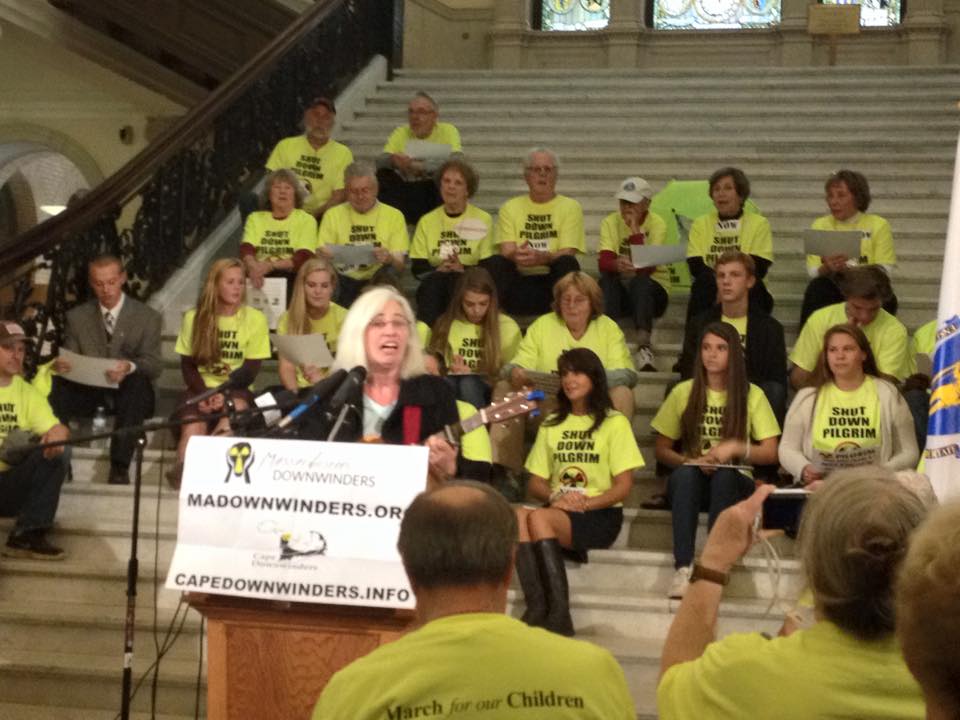 |
| Photo by Cole Harrison - Massachusetts Peace Action (MAPA) |
The Grand Staircase in the Massachusetts State House reverberated with the call to Close Pilgrim NOW this afternoon as citizens held a two hour speak out On October 22nd detailing every aspect of the problem.
The Pilgrim nuclear plant is operated by Entergy Corp. which has said it will close the reactor in 2019. Even the nuclear-loving NRC (Nuclear Regulatory Commission) has designated this plant one of the three most unsafe in the nation.
From the crowded spent fuel rods on the roof (just like at the failed Fukushima reactors) to the fire safety measures that have never been implemented to the financial losses in the hundreds of millions, this plant is highly dangerous for Eastern Massachusetts. There is no possible way to evacuate the 4 million people who would be in danger should the plant go critical.
Longtime leaders in the struggle to shut down a number of reactors Deb Katz (Citizens Awareness Network) and Mary Lampert (Pilgrim Watch) said we have entered the most dangerous time period while the plant is so badly managed and still operating, before shut down and decommissioning begins.
Bills pending at the State House abound - for requiring Entergy to fund decommissioning, to prevent taxpayer subsidies for the company and to re-direct tax funds to clean energy and conservation. The next significant date in the struggle will be on November 17 when some of these bills will be heard in the State House. Politicians helping in the struggle by filing the needed bills include Dan Wolf, from Plymouth and Kathleen O'Connor Ives from Newburyport. The Massachusetts Congressional Delegation has weighed in by sending a letter to the NRC saying state officials need to be involved in the decommissioning process.
I'm glad I left work early (using a couple of hours of personal time) to attend this speakout but I have to say the turnout was light, not every chair was filled. We need many more people to come out for these events. Hundreds, even thousands of people are needed to get the message across to Governor Baker that we need to avert disaster and CLOSE IT NOW!
Friday, September 25, 2015
Radium Girl by Dorian Brooks
Katherine Schaub
was one of hundreds of young women who
worked at the US Radium Corporation in Orange, New Jersey, in the early 20th century, painting numerals on
wristwatch and instrument dials with luminous paint. Many of the women became ill, some
fatally. Schaub died in 1933 at age 31.
1. 1917—1921
I was 15 when the company
hired me. I
loved my job!
It was tricky at first,
shaping the tiny numerals
just right; but I soon caught on.
I’d moisten my brush with my lips
to give it a fine point,
as the foreman taught us.
And we had such fun!
When we turned off the lights,
we saw radium glowing
everywhere—on our clothes
and hair and skin.
Some girls
even painted their teeth
to surprise their boyfriends.
Plus—as the company told us—
we were helping the war effort.
I was so proud.
They never
told us
what radium
does
inside the
body,
nor that its
half-life
is 1600 years.
Tuesday, September 22, 2015
Taking it to Wall Street 1979 - Protesting Nuclear Investments
In the fall of 1979, New England activists joined with New York activists to “Take It To Wall Street” and protest nuclear investments on the 50th anniversary of Black Tuesday (the date of the stock market crash that plummeted the world into the Great Depression in 1929).
This action was organized to draw the connections between finance and profit in the nuclear industry that was making money by manufacturing weapons and building nuclear power plants.

This action was organized to draw the connections between finance and profit in the nuclear industry that was making money by manufacturing weapons and building nuclear power plants.

Monday, September 21, 2015
Trident Submarine Protests 1979 - Now
1979
On a bitterly cold morning in early March of 1979, one full busload and one van of peace and anti-nuclear activists left Worcester to go to Groton, Connecticut to protest a Trident Submarine launch (or christening?) at General Dynamics Electric Boat Corporation.
At that time, one Trident Submarine carried enough nuclear warheads to wipe out six hundred cities around the world all at once. The trigger for all this destruction was a Colt 45 pistol, exemplifying the cavalier “cowboy” fantasy.
Crowds of very well-dressed people walked on the inside of a chain-link fence to welcome, bless, and worship that submarine.
Crowds of not so well-dressed people stood outside the fence to protest the submarine death machine that could cause so much destruction. A lady in a navy blue coat and white gloves on her way in to worship, told us: “I’m praying for you.” Someone on our side of the fence said drily, “We are praying for you, too.”
On a bitterly cold morning in early March of 1979, one full busload and one van of peace and anti-nuclear activists left Worcester to go to Groton, Connecticut to protest a Trident Submarine launch (or christening?) at General Dynamics Electric Boat Corporation.
At that time, one Trident Submarine carried enough nuclear warheads to wipe out six hundred cities around the world all at once. The trigger for all this destruction was a Colt 45 pistol, exemplifying the cavalier “cowboy” fantasy.
Crowds of very well-dressed people walked on the inside of a chain-link fence to welcome, bless, and worship that submarine.
Crowds of not so well-dressed people stood outside the fence to protest the submarine death machine that could cause so much destruction. A lady in a navy blue coat and white gloves on her way in to worship, told us: “I’m praying for you.” Someone on our side of the fence said drily, “We are praying for you, too.”
Sunday, September 20, 2015
Doctors Against Nuclear Weapons/War
Resistance to nuclear weapons has not only come from
peaceniks but from the medical profession.
In 1980, medical doctors from the two Cold War nations (Drs. Bernard Lown, James Muller,
Eric Chivian and Herb Abrams, US and Drs. Eugueni Chazov, Leonid Ilyin and
Mikhail Kuzin, USSR) met and agreed to
organize a physicians movement againsat the nuclear threat.
As physicians, they believed that they had an obligation to
prevent what they could treat.
IPPNW developed a number of important research studies
about the effects of atomic bombs by looking at data collected by Japanese doctors who studied effects of the bombs
dropped at Hiroshima and Nagasaki. IPPNW also documented the heath and environmental effects of the production, testing and
use of nuclear weapons from the 1980s through the 1990s.
In 1985, the organization was awarded the Nobel Peace Prize.
Tuesday, September 15, 2015
Joseph Rotblat, the Only Physicist to Leave the Manhattan Project on Grounds of Conscience
“I saw science as being in harmony with humanity.” When nuclear physicist and peace activist Joseph
Rotblat accepted the 1995 Nobel Peace Prize at the age of 88, he opened his
address with those words. Nothing in his
long career exemplifies his outlook more than his decision in 1944 to quit the
Manhattan Project at Los Alamos for reasons of conscience – the only physicist
to do so.
Rotblat was born in Warsaw in 1908 into a relatively
prosperous Jewish family. With the
beginning of World War I, however, things became difficult for them as they
began to endure poverty and hunger.
Rotblat found work as an electrician but dreamed of becoming a
physicist. He managed to enroll as a
student at the Free University of Poland, where he earned an MA degree in
physics in 1932, and earned a doctorate
in physics at the University of Warsaw in 1938.
He then held two positions: Research Fellow in the Radiological
Laboratory of the Scientific Society of Warsaw, and in 1937, assistant Director
of the Atomic Physics Institute of the Free University of Poland.
Early in 1939, Rotblat began to experiment with uranium. That year he learned of the fission of
uranium and devised an experiment bombarding uranium with neutrons to determine
whether neutrons were emitted in the process.
On finding that more neutrons were emitted than produce fission, Rotblat
realized that this could lead to a chain reaction in which the enormous amount of
energy released could cause a violent explosion – and conceivably be used to
make an atomic bomb.
 |
| Joseph Rotblat - abolishwar.org.uk |
Dover Diary - Recollections of a Rank and File Clam
Bent over double with a forty-pound, borrowed, Boy Scout rucksack on my back, I was stumbling down Route One in New Hampshire on a Saturday morning at the end of April in 1977.
Speaking at my college, George Wald[1] had said if you believed in justice, freedom, democracy and America, you would sign up for nonviolence training in preparation for the Seabrook occupation. During the training session, moved by role-playing an “occupier,” and singing Woody Guthrie’s, “This Land is Your Land,” I decided to join in the protest.
I formed an affinity group with school friends and local folks in Worcester, Massachusetts. We prepared ourselves by arranging equipment and food, discussing possible scenarios, naming ourselves the “Worcester Quahogs.” We were going to be camping out, and needed sleeping bags, backpacks, food and water. The morning we left, New Hampshire Governor Meldrim Thomson was quoted in The Boston Globe saying, “Terrorists were descending on New Hampshire.” I remember our apprehension as we looked at each other; we did not know what to expect.
We drove to the New Hampshire seacoast and arrived at a farm that was a staging area for the protest. We formed a huge circle with other occupiers and everyone sat on the person behind them: “United we sit.” This was to encourage trust. I slept outdoors for the first time in my life.
The next morning, after eating oatmeal prepared by our support person and putting on all our gear, we set out. By the time we reached Route One, I was bent double under the weight of my borrowed Boy Scout rucksack and my heels were blistered from my boots, but I was determined to keep up with my group. We entered the site easily, with more than a thousand people marching onto it from various access points; some even came by boat. We danced in circles on the site, elated, chanting “No Nukes!”
As it got dark, we set up tents and prepared ourselves for whatever would happen next. Streets were established, one named for Karen Silkwood. Karen Silkwood was a worker at a Kerr-McGee plutonium[2] production facility in Oklahoma. She became a union activist in the Oil, Chemical and Atomic Workers Union (OCAWU) and began to uncover serious safety violations at the plant. After being deliberately contaminated by plutonium in her home, so that she set off alarms arriving at work, she died in a suspicious car crash while on her way to a meeting with a New York Times reporter and union official. Documents that friends and family attested that she had with her were missing. Local authorities attributed the crash to her falling asleep at the wheel. After a decade of litigation, her estate accepted a 1.3 million dollar out of court settlement with Kerr-McGee. Her friends put a sign saying “Karen Silkwood – Vindicated,” on the road where she had died.
A little walk from the new town of “Freebrook,” behind some bushes, there were two trenches (his and hers) that served as bathrooms–another first. Every New England state except Massachusetts had sent troopers to assist the New Hampshire authorities. They were around, watching us use the trenches, flying over the site in helicopters. I particularly remember the Rhode Island State Troopers–they looked like German storm troopers to me with their jodhpur-like trousers.
One of my most powerful memories is a pantomime baseball game that happened on Sunday just before the arrests began. There was no bat (it would have been considered a weapon) and no ball, but the crowd knew just when to cheer as the home runs were hit. A completely spontaneous moment that seemed perfectly choreographed.
When the arrests began, I was in an area close to the buses that had been brought onto the site. The troopers arrested the men from our group first; when it became clear that the women were not going to leave, they arrested us as well. Although our group was now fragmented, I was still with Jane, my freshman year roommate and friend. We managed to stay together through the hours following the arrest. First we were held on the bus, then we were crammed into a cattle-car without windows; we counted off to find there were 75 of us in there. Someone started chanting “Om” and everyone took it up. A breeze of fresh air swept through the car as if by magic.
Finally, we were called into the Portsmouth Armory for fingerprinting, matched with our arrest photos, and arraigned. Following arraignment, Jane and I waited together, and then in an awful moment were separated and sent to different armories. I was on a bus going somewhere at 3 or 4 a.m.–had I ever been up that late before?
I arrived at Dover Armory, tottered in, saw Denise from my affinity group, thought to myself everything will be o.k., unrolled my sleeping bag, and went to sleep. In the morning we re-formed affinity groups with whomever was near us and called ourselves “Dunkin’ Meltdown” after the breakfast the National Guard provided.
We were detained for 12 days in the armories around New Hampshire. We read the newspaper coverage of our protest: we were in all the newspapers–local, national, international–and on TV news. New Hampshire authorities had been caught off-guard and did not know how to handle the situation. This became clearer over the next few days as people were brought into court and sentenced to jail in a “sharp break with legal practice” (NYT, 5/6/77) following an “unusual” appearance in court by then State Attorney General David Souter[3].
By agreeing in advance amongst ourselves to “bail solidarity,” and insisting on being released on our word that we would return for trial (personal recognizance), protesters threw a monkey wrench into the legal system. This agreement had several purposes: it protected people who had been arrested the previous year from being singled out and treated more harshly, it prevented the state from getting our cash, and it brought the issue of nuclear power into focus. We were prepared to sit in jail a long time to make these points. We made the authorities nervous, they refused to release us, and we refused to play by their rules. We took away the power they derived out of people’s fear of the stigma of being arrested and going to jail.
The armory experience was many things–lonely, exhilarating, tiresome. We got sick and had to have doctors brought in. We insisted on vegetarian meals. We refused to have male and female sides of the room and the guardsmen had to forcibly separate us. The guardsmen began to like us; one of them named his puppy “No Nukes Luke.” We sang songs all day and half the night. We held an impromptu graduation ceremony for someone who was missing his real graduation. Students who hadn’t finished their semesters were awarded amnesty by various universities. We cheered when people had to bail out to return to families and jobs. I finally called my family to tell them I was fine and managed to convince my dad that the guardsmen would not shoot us like at Kent State. Some people from the Fenway neighborhood in Boston who were in my armory wrote a song to the tune of “Daisy, Daisy” (“Dover, Dover, Dover Armory, it’s been full of the likes of you and me, we just staged a peaceful sit-in, nuclear power should be forbidden, so we believe we’re detainees of the nuclear industry. Clamshell, Clamshell we’re hanging in there with you, we want clean air and healthy children too…”).
Our armory drafted and signed a public letter quoted in the New York Times (5/7/77): “Radioactivity is a silent and invisible killer. You cannot see it, hear it, or taste it. Can we tolerate having such a killer in our midst? Having such a killer strangle our planet? We believe the answer is no.”
I had a deck of cards and played hours of solitaire; I still have that deck of cards. I got a love letter through Core Support that I still have. I still have half my armband (I shared the other half with someone in my affinity group who had lost his) as well as the Clamshell Alliance button given to me by the late, great Guy Chichester, a legendary leader in and hero of the New England anti-nuclear movement.
We made history during those two weeks. We maintained the principal of bail solidarity. When the authorities finally released us, some 700 of us were still in the armories. Freedom and the reunion with my original affinity group was a truly joyous moment. The grass was green, the sky was blue, we were free and it was on our terms.
When I look back I see that we successfully brought the issue of nuclear power to our nation. My own parents changed their minds about nuclear energy as a result of my participation in the demonstration. No new plants have been ordered for more than 20 years, many were canceled and the rest straggled on line under great protest. I feel I had the incredible good luck to participate in a genuine revolutionary moment along with some of the best people I have ever had the privilege to know and love.[4]
[1] Nobel Laureate in Physiology or Medicine, 1967. Harvard professor, important anti-war voice.
[2] Plutonium is a highly radioactive byproduct of the nuclear cycle, used in bombs, lasts tens of thousands of years and is lethal if inhaled.
[3] David Souter went on to serve as an Associate Justice of the Supreme Court of the U.S. from 1990-2009.
[4] From Dover Diary-Recollections of a Rank and File Clam, in Peacework Magazine, July/August 1996, New England Regional Office of the American Friends Service Committee, Cambridge, Massachusetts.
Speaking at my college, George Wald[1] had said if you believed in justice, freedom, democracy and America, you would sign up for nonviolence training in preparation for the Seabrook occupation. During the training session, moved by role-playing an “occupier,” and singing Woody Guthrie’s, “This Land is Your Land,” I decided to join in the protest.
 |
| On site with affinity group - photo Russell Puschak |
The next morning, after eating oatmeal prepared by our support person and putting on all our gear, we set out. By the time we reached Route One, I was bent double under the weight of my borrowed Boy Scout rucksack and my heels were blistered from my boots, but I was determined to keep up with my group. We entered the site easily, with more than a thousand people marching onto it from various access points; some even came by boat. We danced in circles on the site, elated, chanting “No Nukes!”
 |
| Tent City on site - photo Russell Puschak |
A little walk from the new town of “Freebrook,” behind some bushes, there were two trenches (his and hers) that served as bathrooms–another first. Every New England state except Massachusetts had sent troopers to assist the New Hampshire authorities. They were around, watching us use the trenches, flying over the site in helicopters. I particularly remember the Rhode Island State Troopers–they looked like German storm troopers to me with their jodhpur-like trousers.
One of my most powerful memories is a pantomime baseball game that happened on Sunday just before the arrests began. There was no bat (it would have been considered a weapon) and no ball, but the crowd knew just when to cheer as the home runs were hit. A completely spontaneous moment that seemed perfectly choreographed.
When the arrests began, I was in an area close to the buses that had been brought onto the site. The troopers arrested the men from our group first; when it became clear that the women were not going to leave, they arrested us as well. Although our group was now fragmented, I was still with Jane, my freshman year roommate and friend. We managed to stay together through the hours following the arrest. First we were held on the bus, then we were crammed into a cattle-car without windows; we counted off to find there were 75 of us in there. Someone started chanting “Om” and everyone took it up. A breeze of fresh air swept through the car as if by magic.
 |
| Men from the Worcester AGs in armory - photo Russell Puschak |
I arrived at Dover Armory, tottered in, saw Denise from my affinity group, thought to myself everything will be o.k., unrolled my sleeping bag, and went to sleep. In the morning we re-formed affinity groups with whomever was near us and called ourselves “Dunkin’ Meltdown” after the breakfast the National Guard provided.
We were detained for 12 days in the armories around New Hampshire. We read the newspaper coverage of our protest: we were in all the newspapers–local, national, international–and on TV news. New Hampshire authorities had been caught off-guard and did not know how to handle the situation. This became clearer over the next few days as people were brought into court and sentenced to jail in a “sharp break with legal practice” (NYT, 5/6/77) following an “unusual” appearance in court by then State Attorney General David Souter[3].
By agreeing in advance amongst ourselves to “bail solidarity,” and insisting on being released on our word that we would return for trial (personal recognizance), protesters threw a monkey wrench into the legal system. This agreement had several purposes: it protected people who had been arrested the previous year from being singled out and treated more harshly, it prevented the state from getting our cash, and it brought the issue of nuclear power into focus. We were prepared to sit in jail a long time to make these points. We made the authorities nervous, they refused to release us, and we refused to play by their rules. We took away the power they derived out of people’s fear of the stigma of being arrested and going to jail.
The armory experience was many things–lonely, exhilarating, tiresome. We got sick and had to have doctors brought in. We insisted on vegetarian meals. We refused to have male and female sides of the room and the guardsmen had to forcibly separate us. The guardsmen began to like us; one of them named his puppy “No Nukes Luke.” We sang songs all day and half the night. We held an impromptu graduation ceremony for someone who was missing his real graduation. Students who hadn’t finished their semesters were awarded amnesty by various universities. We cheered when people had to bail out to return to families and jobs. I finally called my family to tell them I was fine and managed to convince my dad that the guardsmen would not shoot us like at Kent State. Some people from the Fenway neighborhood in Boston who were in my armory wrote a song to the tune of “Daisy, Daisy” (“Dover, Dover, Dover Armory, it’s been full of the likes of you and me, we just staged a peaceful sit-in, nuclear power should be forbidden, so we believe we’re detainees of the nuclear industry. Clamshell, Clamshell we’re hanging in there with you, we want clean air and healthy children too…”).
Our armory drafted and signed a public letter quoted in the New York Times (5/7/77): “Radioactivity is a silent and invisible killer. You cannot see it, hear it, or taste it. Can we tolerate having such a killer in our midst? Having such a killer strangle our planet? We believe the answer is no.”
I had a deck of cards and played hours of solitaire; I still have that deck of cards. I got a love letter through Core Support that I still have. I still have half my armband (I shared the other half with someone in my affinity group who had lost his) as well as the Clamshell Alliance button given to me by the late, great Guy Chichester, a legendary leader in and hero of the New England anti-nuclear movement.
We made history during those two weeks. We maintained the principal of bail solidarity. When the authorities finally released us, some 700 of us were still in the armories. Freedom and the reunion with my original affinity group was a truly joyous moment. The grass was green, the sky was blue, we were free and it was on our terms.
When I look back I see that we successfully brought the issue of nuclear power to our nation. My own parents changed their minds about nuclear energy as a result of my participation in the demonstration. No new plants have been ordered for more than 20 years, many were canceled and the rest straggled on line under great protest. I feel I had the incredible good luck to participate in a genuine revolutionary moment along with some of the best people I have ever had the privilege to know and love.[4]
[1] Nobel Laureate in Physiology or Medicine, 1967. Harvard professor, important anti-war voice.
[2] Plutonium is a highly radioactive byproduct of the nuclear cycle, used in bombs, lasts tens of thousands of years and is lethal if inhaled.
[3] David Souter went on to serve as an Associate Justice of the Supreme Court of the U.S. from 1990-2009.
[4] From Dover Diary-Recollections of a Rank and File Clam, in Peacework Magazine, July/August 1996, New England Regional Office of the American Friends Service Committee, Cambridge, Massachusetts.
Subscribe to:
Posts (Atom)